
Rotate To Win!
Keeping bites coming in the toughest of condtions can be difficult but according to Michael Buchwalder, it’s just a case of swim rotation…
Winter fishing is difficult at the best of times, and after a long cold spell where venues were frozen for over a week in some cases, conditions don't get much more difficult than when the ice finally melts.

There are however a few tricks you can employ to help you put some fish in your net though! Weights won't be huge and bites hard to come by but with a considered approach, you can enjoy some great fishing and match results in the process.
We've met up with former World Feeder Champion, Michael Buchwalder at the wonderful Alders Farm Fishery in Buckinghamshire to look at some tactics that have helped him to great results over the years, especially when the fishing is at its hardest.
According to Michael, it's not all about one particular tactic being the focus of his efforts, but fishing in conditions like these when the water is at its coldest and one frost refreezes the lake, rotating several lines is always his first line of attack.

To demonstrate how catching big weights of commercial silver fish can be possible even in the coldest conditions, we decided to fish Oak Lake at Alders Farm, where there are lots of smaller perch to be caught, but it’s the head of rudd and skimmers we hope to find to put a weight together.
Take It Easy!
With the lake being frozen just a day or so before we shot this feature, the last thing we want to do is start piling in loads of bait, frugal feeding will be key and keeping several lines going at once, vital to getting bites consistently.
I’ve plumbed up two 13 metre lines using my TKS G-Series G50 pole in 7ft of water today, these are positioned at 10 and 2 O’clock positions, allowing some space so when I’m catching on one line, I won’t be disturbing the other.

I also plumbed a short line at 5 metres where I can catch these perch, again another line to move to, and with the fish being around 8 to the pound, I can put some weight in the net while I nurture those longer lines where I hope to catch the bigger fish.
By making my longer line at 13 metres, it also gives me the option of going longer if the fish back away. But with us being the only anglers mad enough to be out on the bank today, I feel I should be able to bounce between the two, top up with perch short and have a steady day filled with bites.
I’m going to feed two small balls of Aquastim Biogrub Dark on the right-hand line, and just one ball on the left-hand side, both with a few pinkies and maggots included.

Short I’m just going to feed a golf ball sized ball of groundbait and loose feed, I don’t expect to catch many skimmers on this line and perch will be the main quarry, so a loose feed approach may be best.
I’m also going to ping a few maggots over the longer lines too initially to try and drag a few fish into the peg, but when those bigger fish arrive, I will try to use the pot more and focus those fish on the bottom and attract fewer small fish.
The Set Up
Rig wise, this is going to be a super simple day the peg is around 7ft deep at 13 metres, so I’ve selected a 0.5g MAP F1 Carbon float, set up on 0.13mm Optimum Power down to a six inch hook length of 0.09mm Optimum Power and a size 18 silver fish pellet hook.

A bulk and three droppers shotting pattern give me the option of changing things around, I can spread it out, but if those skimmers turn up, I can also change to a double bulk rig too, so it’s just about being versatile.
I have used a similar set up on the short line, but it’s around five feet deep here, and a 0.3g F1 Carbon float is better suited.
Because I expect to catch a wide range of fish today with anything from 1oz to 4lb possible, elastic choice becomes quite important. Coupled with the depth, you need to ensure you’re setting the hook, or lost fish can become a common occurrence.

A 4-6 MAP TKS Solid Core Hybrid elastic set ‘pingy’ in the top kits is the perfect happy medium wherever I go, coupled with a Side Roller Puller Kit, I can get a bit of control over any bigger fish I may encounter too.
Don’t Get Greedy…
Starting today’s session I baited up with double pinkie and went straight out on the negative 13 metre line where I fed a single ball, and straight away I was getting bites from perch but also some quality rudd too which was a welcome surprise.

Loose feeding a few maggots over the top certainly got the small fish feeding, but was I missing out?
With this being a thought in my mind I didn’t loose feed on the positive line to the right, just so I could see the difference between the two. If feeding with the catapult was best, it’s easy to just start feeding the other line, but it can be the way you feed that helps you find those bigger fish, so a bit of experimentation is always needed to work it out.
After a good run on the left hand line, but no better fish I was keen to try the line to the right which was fed more positively with groundbait. This time the hook bait was double red maggot which would hopefully stand out and pick out a better fish.

Straight away again, I was into a few small fish, but on my fourth chuck I hooked my first quality fish of the day, a skimmer of over a pound and on such a cold day, a big bonus!
With a few more skimmers falling to this line, I decided that the other line could be just as good, but with the loose feed attracting the smaller fish, I decided to pot a small golf ball of groundbait on that line and stop feeding with a catapult to try and get two lines going.

You mustn’t get greedy when fishing for fish like skimmers, they can soon get spooked and move off, so if you can get into the scenario of catching off two lines and bouncing between them, you can catch for longer and the fish are far more confident than when trying to catch them down the same hole.
A Red Letter Day!
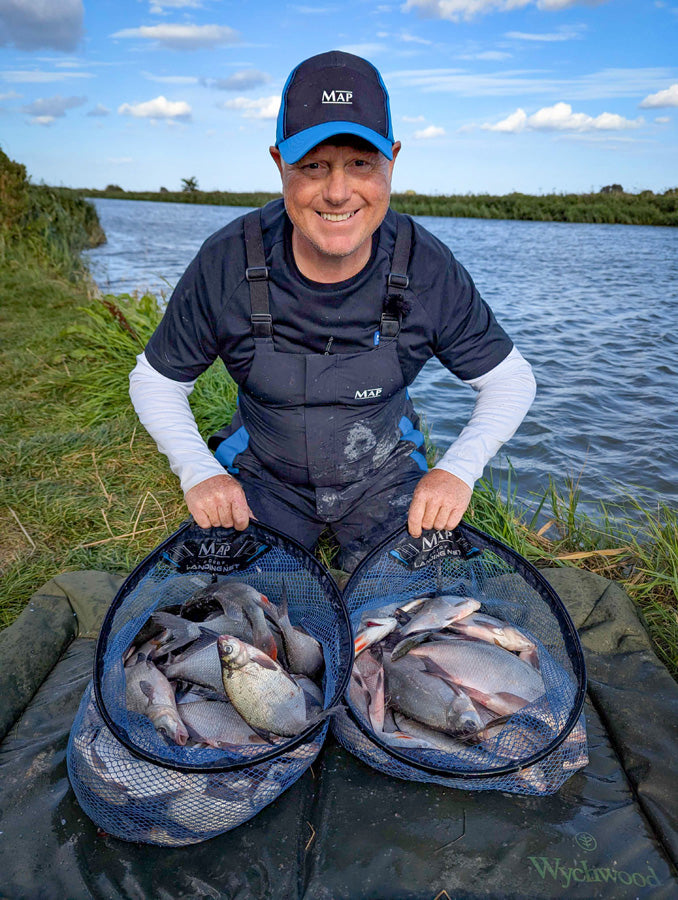
Our session at Alders Farm soon turned into a special one! Considering how long the venue had been frozen for, a 15lb catch would have been brilliant but we were catching skimmers incredibly well.

After feeding the other 13 metre line more positively, I was soon catching skimmers there as well and I was able to catch a couple of fish, top it up with a small golf ball sized ball of groundbait with a few pinkies and maggots included and switch to the other line while that settled.

By doing this, I was putting skimmers between 8oz and 2lb in the net most casts, with the odd small perch appearing when it was time to top up. The fish seemed hungry after the ice and we fed a lot more groundbait in the end than I’d expected to at the start.
Should I have put more in at the start? Absolutely not, fishing in this was is all about the fish telling you how they want it on the day, and by feeding the two long lines differently, I quickly realised what was happening – the skimmers wanted some bait on the bottom, but the smaller fish flocked to any loose feed and catching better fish was unlikely.

With the way my lines were fed, it enabled me to switch one too, so I ended up with two perfectly prepared swims to plunder.
I cannot stress enough how important it is in the winter to have a few lines to rotate, if the fishing is really good, two lines will be ample, if it’s not so good then my two 13 metres lines, the 5 metre line to put some perch in the net and maybe a longer line too would be needed to help me eek out those bites to put a decent weight together.

It had been an amazing day, and with over 45lb of skimmers, perch and rudd in the net in just a little over four hours fishing, we decided to call it a day. Make sure you give this approach a try, it will definitely put more fish in your net on a cold day no matter how hard the fishing might be.