
Into The Deep
Deep waters can provide additional challenges for the feeder angler, but there are a few tricks to stack the odds in your favour! MAP’s Tony Curd explains…

With the majority of venues we fish being 10ft and shallower, the prospect of facing a venue with over 20ft of depth can be a daunting prospect for many anglers! With more depth there are a range of additional challenges you’ll face in your quest for deep water glory!
Depth aside, it’s the behaviour of fish in deep water venues that provides the greatest challenge in my opinion. Despite being associated with being a bottom feeding species, Bream actually spend very little time on the bottom, only dropping down to feed for short periods before moving back up in the water column.

Getting the fish to drop down in the water is what you have to keep in mind when targeting deep water and quite often it’s all about activity and making it happen to achieve this.
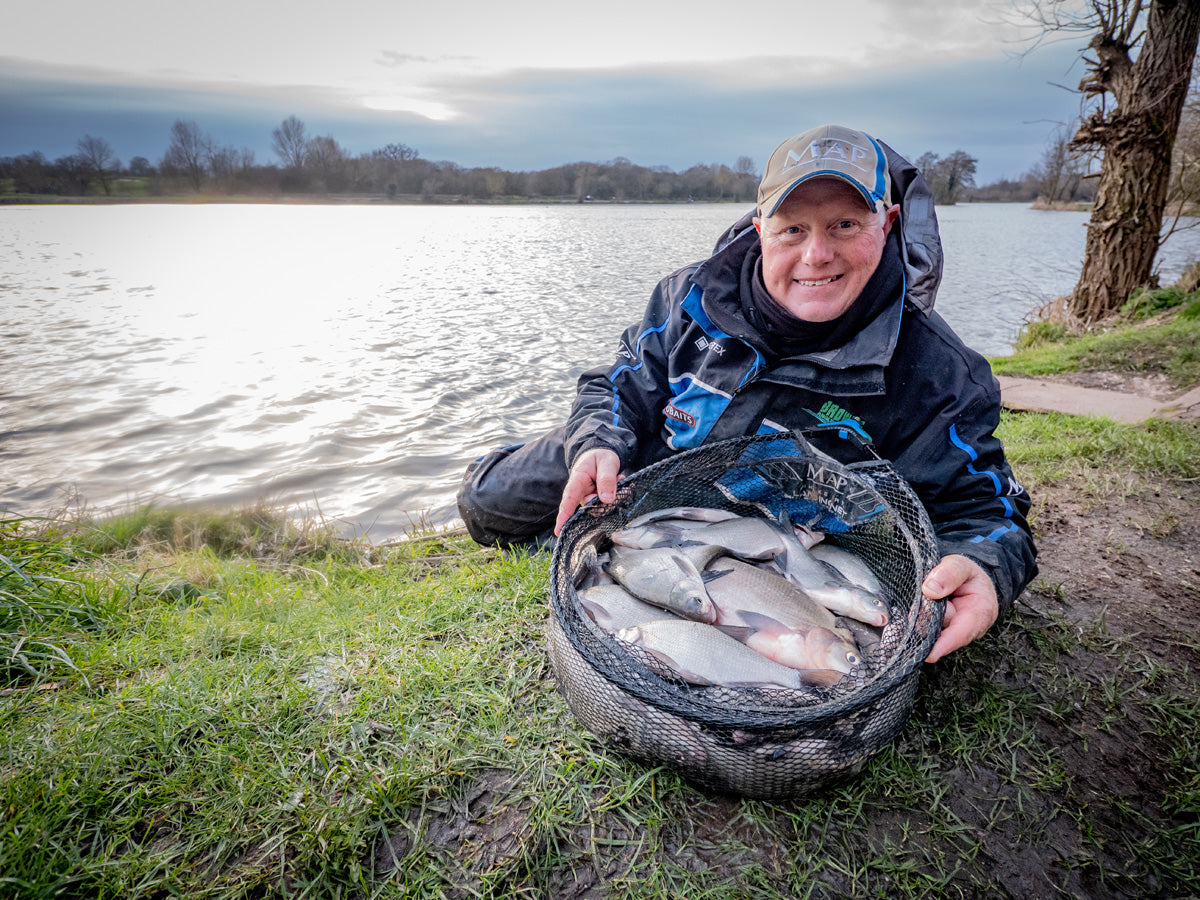
I’ve come to a deep farm reservoir to try and put a few of the venues big bream on the bank and talk through a few tactics that have worked for me many times in matches on venues which seem to be bottomless!
Selecting The Correct Depth
Out in front of me, we’ve got a pretty featureless bowl with steady slopes on both banks going down to around 23ft in the middle of the lake this means you’re into deep water whatever range you decide to fish at but it’s still important to give yourself a couple of options when it comes to depth.

I’ve clipped up one rod at 50 metres which puts me in the deepest water right down the middle of the lake which is great if the fish are more comfortable further away from the bank.
Something that can also work and give you an opportunity of catching a bit more of a mixed bag if the venue holds plenty of roach, perch and skimmers, or even just catching well late in the match is to feed a shorter line in slightly shallower water on the slope.

At 18 metres today I’ve found 15ft of water which is considerably shallower than the longer line and gives me another option. One of the main reasons for selecting a shallower area is that because the fish naturally sit off the bottom in deep water, if they’re particularly reluctant to drop down in the deepest water.
On the shallower line they’ll always be naturally closer to the bottom, meaning your chances of a bite will always be greater.
Drag Em’ Down!
As I have already mentioned, the biggest challenge in deep water is getting the fish to go down onto the deck to feed. To do this, there are several tricks you can try to give yourself a better chance of success.
The first is your initial feed with a bait up feeder, these are great for getting an amount of bait accurately on the bottom but what they are also very useful for is emptying the feeder at half to ¾ depth to leave a cloud of bait in the water column.

By doing this you can get a quick response from the fish as they follow it down and bite can follow soon after, which you probably wouldn’t have had! The bait up feeder shouldn’t be seen as something you only use at the beginning of a match either!
I like to use this to provoke a response from the fish at any stage if I feel they are sitting above the feeder and refusing to drop down, and the difference can be just a single bait up feeder emptied off the bottom.

Leaving a little bit of bait in the water column is also another reason why I choose cage feeders for the majority of my feeder fishing in deep water, you can always play around with how hard the bait is pressed in and the consistency of your mix, but what they always allow is that attraction which is needed to get a bite on difficult deep-water venues.
Window feeders also have a place but these can be effective when the fishing scenario is in reverse, typically when fishing for smaller fish but if you’re getting regular bites on the bottom and you feel the fish are being moved up and down in the water with bait falling through.
This more inert feeder style can be a great way of settling the peg down again, and focussing the fish on the bottom.
Simple Tactics & Bait Choices
Tangles can be a problem when fishing in deep water, so it pays to keep your rigs very simple! Today on both of my lines I’ve gone with a simple running rig, running on the line I have a small feeder link which runs to a line stop which is butted against the knot of a 4-inch twisted boom.

By having the twisted boom, it kicks the hook length away from the feeder assisting in bite detection but also keeping tangles to a minimum. This is also aided by using heavier hook lengths, and as a minimum I’ll use a 0.15mm MAP Optimum Power, starting at 60cm tied to a size 14 B560 hook.

Rod wise, I’ve selected a Parabolix Black Edition Pro 12ft Feeder for the long line, and an 11ft Parabolix Pro Ulralight feeder for the shorter line where I could catch some smaller roach, perch and skimmers as well as bream.

Both rods are teamed up with 5000 sized Parabolix reels, loaded with 0.12mm Agitator braid with an 8lb shockleader attached. Braid is quite important in deep water even at close range bite detection can be tricky so braid is always my first choice.

On the bait tray we’ve got a straight forward array of baits – the groundbait mix is a strong fishmeal mix which appeals to the big bream I’m hoping to catch and is made up of Dynamite Baits Green and Black Swim Stim.

With this I’ve got plenty of micro pellets, which are one of my favourite baits to feed when bream are the target this is a mix of 2mm standard micros and yellow F1 Sweet pellets which once again go back to drawing those fish down to the bottom, a little bit of colour in the mix can pay off at times and I always have a few yellow pellets mixed in.
When it comes to live bait I’ve bought some live and dead maggots which are always a safe option, some worms and some corn in case the small fish are a problem and that is as complicated as it gets!
The Session
I arrived at the venue to find it quite busy, which was a surprise for mid-week but with some more favourable spring-like conditions I found myself a peg between the carp anglers at the windward end of the lake and got set up hopeful of a few bites.

At the start I fed 10 big bait up feeders on the long line, packed with bait to get a bed down. Seven of these were emptied on the bottom, with the last three emptied at half depth to get some bait falling through the water.
The short line received just five bait-ups but until I get an idea of what the fishing is going to be like, I like to keep my options open without ruining my chances.

Baiting up with two red maggots, the 40g cage feeder was loaded with groundbait and a few free offerings and cast out to the clip, after a long drop it finally hit the bottom in 22ft of water and I sat back and waited for a sign…
No bites on the first two casts was actually a good sign, when there are no quality fish in the area it can be common to get hounded by small perch on this venue so their absence suggested that a few better bream could be in the area, and quite possibly, above the bait!

A liner on the fourth cast prompted me to empty another bait up feeder at half depth and then chuck straight over it, this worked as after 3 minutes the tip pulled round positively and I was into my first bream of the day.
After a heavy scrap, a big bream of over 8lb slid over the landing net a lovely fish and typical of what I was hoping to catch today. The presence of those fish given away by the liner and dragging one down which I may not of caught without being active just proved that deep water fishing is very different to that on shallower venues.

After that first fish, I didn’t have any further indications, so a couple of bait up feeders were deployed and a look on the short line was my next move! With the fish clearly up in the water over the deepest water, I hoped they’d find the bait I’d fed short quicker.
First cast on a double red maggot hook bait I had a few indications before the tip pulled round enough to provoke a strike, a smaller fish this time of around 3lb but a good sign the change in depth may have paid off.
A couple of smaller skimmers and a perch followed but I was keen to drop over that long line again to see if any fish had moved back over the feed I’d introduced.

Liners were once again present and after a couple of minutes a small pull on the braid between the reel and the first ring to move the feeder along the bottom caught the eye of a fish and got the response I was after; another big bream was hooked.
This one was bigger than the first and after weighing it at the end, actually tipped the scales at just over 9lb! Such is the nature of fishing for fish like this they can come in spells and I wasn’t shocked to get another bite on the next cast resulting in another quality fish.

The rest of the session was spent topping up with the bait up feeder after each fish to drag more fish down to the depths with a few casts short to try and take advantage of a late run if it occurred.
Rotating the two lines worked well and caught me an odd big bream through to the end of our session and with 7 bream in the net for well over 40lb it had been a brilliant day.
Fishing in deep water isn’t like anything else, and the tactics you need to employ are very different to most venues you’ll go to, but get it right by continually working the swim hard and the rewards and there to be had.